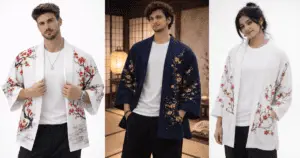
Japanese Haori Fashion AI Prompt Guide 2026 is designed for creators who want to generate professional studio-style fashion visuals using AI image tools. This detailed guide explains how to use the prompt correctly, improve realism, optimize lighting, and maintain accurate fabric texture in AI-generated outputs.
If you are building high-quality AI fashion visuals, portfolio images, or aesthetic social media content, this structured prompt guide will help you achieve consistent and realistic results.
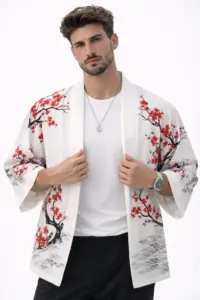
Japanese Haori Fashion AI prompt example white linen haori with red floral pattern studio styleJapanese Haori Fashion AI Prompt Example
What Is Japanese Haori Fashion AI Prompt?
The Japanese Haori Fashion AI Prompt is a structured instruction set used in AI image generators such as Midjourney, Stable Diffusion, and similar tools. It focuses on realistic clothing details, natural body proportions, and professional studio lighting.
- White linen haori with red floral details
- Neutral white studio background
- Soft diffused lighting
- Sharp linen fabric texture
- Natural color balance
- Minimalist styling
This prompt ensures that the clothing remains the focal point while preserving natural proportions and realistic output.
Complete AI Image Generation Prompt – 1
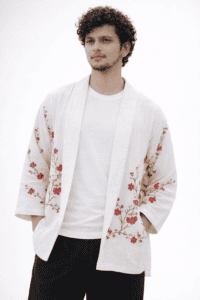
Copy the full prompt below:
Use the uploaded reference image as the only and absolute source of facial identity and body structure.
The face must match exactly — identical facial structure, jawline, eyes, eyebrows, nose shape, lip shape, beard density, skin texture, hairline, hairstyle, and facial proportions.
Do not beautify, modify, reinterpret, de-age, re-ethnicize, stylize, or enhance the face.
The same man stands in a professional white studio setting wearing:
- Pure plain white T-shirt (strict neutral white)
- White linen haori featuring red floral and branch patterns only
- Black loose trousers (mostly cropped out)
Soft diffused lighting, bright natural color balance, sharp focus, realistic linen fabric texture, 9:16 aspect ratio.
Prompt – 2
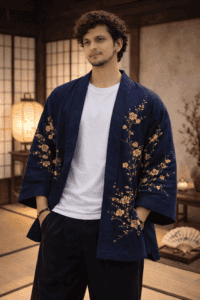
Copy the full prompt below:
Use the uploaded reference image as the only and absolute source of facial identity and body structure.
The face must match exactly — identical facial structure, jawline, eyes, eyebrows, nose shape, lip shape, beard density, skin texture, hairline, hairstyle, and facial proportions.
Do not beautify, modify, reinterpret, de-age, re-ethnicize, stylize, or enhance the face.
The same man stands in a traditional studio background wearing:
- Beige traditional inner T-shirt (neutral tone)
- Maroon linen haori with subtle gold floral and branch patterns only
- Black loose trousers (mostly cropped out)
Authentic traditional background featuring tatami mat floor, shoji screens, soft lantern lighting, and warm wooden decor.
Soft diffused lighting, bright natural color balance, ultra sharp focus, realistic fabric texture, professional portrait quality, 9:16 aspect ratio.
How to Use Japanese Haori Fashion AI Prompt Effectively
To achieve the best output, upload a high-resolution reference image with clear lighting. Avoid blurry or low-quality photos because AI tools replicate input quality. A sharp reference image ensures better facial structure preservation and clothing realism.
Step 1: Choose the Right AI Tool
This prompt works best in tools that support detailed instruction control. Platforms such as ChatGpt
and Stable Diffusion allow advanced parameter tuning.
Step 2: Maintain Neutral Lighting
Neutral lighting preserves accurate white balance. Warm or tinted lighting can distort white linen fabric and reduce realism.
Step 3: Use Correct Aspect Ratio
For Instagram Reels or short-form content, use 9:16 aspect ratio. For blog thumbnails, you may switch to 4:5 or 1:1.
Step 4: Avoid Over-Stylization
Adding excessive artistic filters reduces catalog-style realism. Keep output clean and sharp.
Why Fabric Texture Matters in AI Fashion Prompts
Linen fabric contains visible weave patterns. When properly described in the prompt, AI tools render realistic micro-textures. This enhances product-style visuals and prevents flat, unrealistic clothing output.
Including terms like “realistic linen fabric texture” and “sharp focus” increases detail clarity.
Common Mistakes to Avoid
- Using low-resolution reference images
- Adding conflicting style instructions
- Overloading the prompt with unnecessary effects
- Ignoring lighting consistency
- Using unrealistic color combinations
Best Use Cases for This AI Prompt
- AI fashion concept creation
- Portfolio development
- Creative experimentation
- Prompt engineering practice
- Social media fashion visuals
Internal Resources
Explore More Fashion AI Prompts
Visit Main Saraprompts Website
Frequently Asked Questions
Is this Japanese Haori Fashion AI Prompt beginner friendly?
Yes. You simply copy the prompt, upload a reference image, and adjust the aspect ratio based on your platform.
Can I modify the clothing color?
Yes, but keep lighting neutral to preserve realistic output.
Which aspect ratio works best?
9:16 works best for social platforms. For blog previews, 4:5 is recommended.
Final Thoughts
The Japanese Haori Fashion AI Prompt provides a structured method for generating professional fashion-style visuals. By maintaining lighting balance, realistic fabric texture, and clear instructions, you can create high-quality AI-generated images suitable for portfolios and creative content.
Pingback: Holi AI Image Prompt 2026: Create Stunning Ultra-Realistic Holi Images - Sara Prompts
Pingback: AI Traditional Indian Portrait: Create a Mesmerizing Vintage Saree Look in 8K Realism - Sara Prompts